Master AI at your own pace
Structured courses designed for small business owners and teams. From absolute beginners to advanced practitioners, learn the AI skills that matter for your business.

AI Foundations for Business
Build a practical understanding of what AI is, how it creates business value, where it fits in daily operations, and the core language leaders and teams need to evaluate opportunities with confidence.
AI 101 for Business Leaders
Understand core AI concepts, model types, and the difference between automation, analytics, ML, and generative AI.
Where AI Creates Value
Map AI to revenue growth, efficiency gains, risk reduction, and better customer experiences.
Generative AI vs. Predictive AI
Compare common AI approaches and learn when each is the right fit for a business problem.
Essential AI Vocabulary
Learn the terms teams need to speak clearly with vendors, data teams, and executives.
Responsible AI Basics
Introduce fairness, privacy, accuracy, and human oversight as business fundamentals.
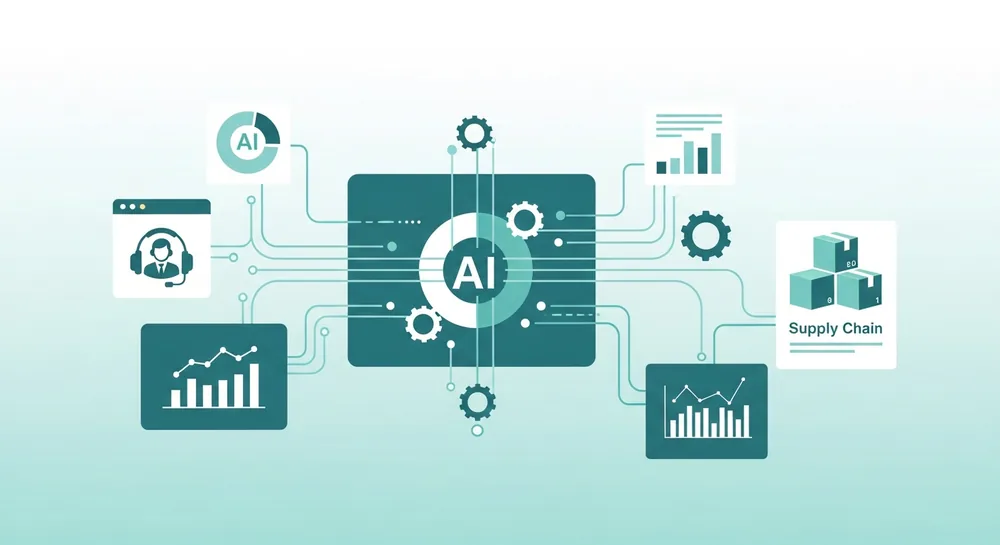
AI Use Cases Across the Enterprise
Survey practical AI use cases across functions such as sales, marketing, service, operations, finance, and HR so teams can quickly spot high-value opportunities inside their own organization.
AI in Sales & Marketing
Explore lead scoring, content generation, campaign optimization, and customer segmentation use cases.
AI in Customer Support
Review copilots, chatbots, routing, sentiment analysis, and self-service support patterns.
AI in Operations
See how forecasting, scheduling, quality control, and workflow optimization improve performance.
AI in Finance & HR
Learn how AI supports reporting, planning, talent screening, onboarding, and policy assistance.
Cross-Industry Use Case Review
Analyze real examples to recognize repeatable patterns that apply across sectors.
Data Readiness for AI
Learn what good data foundations look like, how to judge data quality and availability, and what businesses must do to prepare the information, permissions, and governance AI solutions depend on.
Data Fundamentals for AI
Understand structured, unstructured, internal, and external data used by modern AI systems.
Data Quality Essentials
Learn how completeness, consistency, freshness, and labeling affect AI performance.
Governance Foundations
Define ownership, stewardship, access controls, and approval paths for AI-ready data.
Privacy, Consent & Security
Review the safeguards needed when customer, employee, and proprietary data are involved.
Use Case to Data Mapping
Match business goals to the data required to build, test, and maintain AI solutions.
Prompting & Everyday AI Tools
Teach teams how to use AI assistants productively in day-to-day work with better prompts, safer workflows, clearer task framing, and repeatable methods for communication, analysis, and documentation.
Prompt Design Basics
Write clear, structured prompts that get useful first-draft results from AI assistants.
Task Framing & Iteration
Break complex requests into smaller steps, evaluate output, and refine until it's usable.
AI for Writing & Research
Use AI to draft, edit, summarize, and research faster, without losing your own voice or accuracy.
AI for Meetings & Productivity
Use AI to transcribe, summarize, and follow up on meetings, and to declutter daily work.
Building a Team Prompt Library
Create a shared, governed library of prompts and templates so the whole team levels up together.

AI Strategy & Opportunity Prioritization
Move from isolated ideas to a deliberate AI roadmap by linking opportunities to strategy, scoring them by value and feasibility, and choosing where to start for measurable impact.
Aligning AI with Business Strategy
Connect AI initiatives to growth goals, operating priorities, and competitive advantage.
Opportunity Scoring Frameworks
Evaluate use cases with value, feasibility, urgency, and data readiness criteria.
Building the AI Portfolio
Balance quick wins, strategic bets, and foundational capabilities across the enterprise.
Buy, Build, or Partner?
Decide when to adopt off-the-shelf tools, custom-build, or work with vendors.
Roadmap Planning & Sequencing
Stage pilots, integrations, governance, and scaling plans into a realistic timeline.
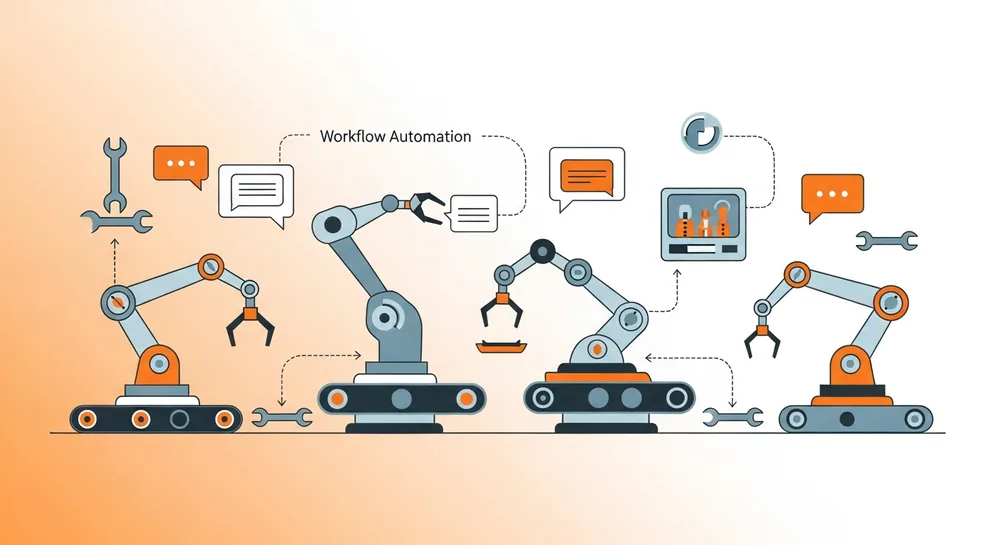
Process Automation with AI
Learn how to redesign workflows with AI and automation, identify tasks best suited for human-AI collaboration, and deploy reliable automations that save time without losing control.
Workflow Discovery & Mapping
Document current-state processes to identify repetitive tasks and decision points ripe for AI.
No-Code & Low-Code Automation
Combine AI tools with automation platforms to trigger actions, approvals, and updates.
Human-in-the-Loop Design
Set escalation rules and review checkpoints for quality, risk, and accountability.
Exception Handling & Controls
Plan for failure cases, edge conditions, and operational resilience in automation flows.
Measuring Automation ROI
Track time saved, throughput, accuracy, and cost improvements after launch.
Building AI-Powered Customer Experiences
Design customer journeys that use AI to improve service, personalization, and responsiveness while protecting trust through smart escalation, knowledge design, and measurable experience standards.
Conversational Experience Design
Design helpful chatbot and copilot interactions that feel clear, useful, and on-brand.
Knowledge Assistants & FAQs
Structure content so AI can answer questions accurately from trusted sources.
Personalization with AI
Use signals, segments, and context to tailor experiences without overreaching.
Escalation & Service Recovery
Build seamless handoffs from AI to human teams when complexity or risk rises.
Customer Experience Metrics
Measure containment, resolution quality, response time, CSAT, and trust indicators.
AI Integration Fundamentals
Introduce the practical architecture and delivery patterns required to connect AI tools to business systems, data sources, and workflows so pilots can move into usable operational solutions.
APIs & Connectors for AI
Learn the basics of integrating SaaS, databases, documents, and business apps.
System Architecture Basics
See how front ends, models, orchestration, storage, and monitoring fit together.
Data Pipelines for AI Workflows
Move data securely between systems for prompting, retrieval, and automation.
Security Patterns for Integration
Apply authentication, authorization, logging, and secret management practices.
Launching the First Integrated Pilot
Scope and deploy a small but valuable AI integration with clear success criteria.
Generative AI Application Design
Go beyond prompts to design robust generative AI applications with intentional user experience, orchestration logic, evaluation methods, and safeguards that support reliable business outcomes.
UX for Generative AI
Design interfaces that set expectations, show uncertainty, and guide effective user input.
Prompt Workflows & Orchestration
Chain prompts, tools, and rules into repeatable multi-step experiences.
Managing Context Windows
Control instructions, memory, and retrieved content to improve answer quality.
Evaluation & Test Design
Create test sets and scorecards to evaluate output usefulness, accuracy, and consistency.
Failure Modes & Recovery
Identify hallucinations, drift, unsafe outputs, and fallback patterns before scale.
Retrieval, Knowledge, & Search
Learn how enterprise knowledge can be prepared, indexed, retrieved, and tuned to power AI assistants that answer from trusted company content instead of guessing.
Preparing Documents for AI
Clean and structure files, pages, and records so they can be searched effectively.
Embeddings & Semantic Search
Understand how meaning-based retrieval improves over keyword search alone.
Chunking & Indexing Strategies
Choose chunk sizes, metadata, and indexing methods that improve relevance.
Retrieval Tuning & Evaluation
Measure recall, precision, grounding, and citation quality in answer systems.
Enterprise Knowledge Assistant Design
Combine retrieval, prompting, and permissions into a practical assistant pattern.
AI Agents & Multi-Step Workflows
Explore how AI agents plan, call tools, maintain state, and complete multi-step tasks while staying bounded by rules, approvals, and operational guardrails.
Agent Patterns & Use Cases
Compare assistants, agents, orchestrators, and autonomous workflow patterns.
Tools, Actions & Function Calling
Enable agents to use APIs, databases, search, and business applications.
Planning, Memory & State
Manage context, task history, and working memory across longer-running jobs.
Approvals, Guardrails & Limits
Control agent permissions, spending, escalation, and completion criteria.
Operating Agentic Systems
Monitor performance, failures, and improvement opportunities in deployed agents.
Machine Learning for Business Teams
Provide a practical view of machine learning concepts and decision frameworks so business teams can collaborate intelligently on prediction, classification, segmentation, and optimization solutions.
Supervised Learning Essentials
Understand prediction, classification, and labeled-data use cases in business.
Unsupervised Learning & Segmentation
Use clustering and pattern discovery to reveal structure in business data.
Features, Labels & Training Data
Learn how training data design affects model outcomes and bias.
Experimentation & Model Selection
Compare candidate models through testing, validation, and business metrics.
When ML Beats GenAI
Decide when conventional machine learning is the better fit than generative AI.
MLOps & AI Operations
Build the operational discipline required to deploy, monitor, maintain, and improve AI systems in production with versioning, incident response, cost control, and lifecycle governance.
Versioning Models, Data & Prompts
Track the assets and changes that affect behavior across deployments.
Deployment Patterns for AI
Compare batch, real-time, edge, and hybrid deployment approaches.
Monitoring, Drift & Performance
Measure model quality, usage, data drift, latency, and business impact.
Incident Response for AI Systems
Prepare for outages, harmful outputs, regressions, and rollback scenarios.
Cost & Performance Optimization
Balance quality, speed, and infrastructure spend in production operations.
Governance, Risk, & Compliance
Establish the policies, controls, and oversight needed to manage AI safely across legal, regulatory, security, privacy, ethical, and reputational dimensions.
AI Policy & Governance Design
Define principles, approval paths, ownership, and decision rights for AI usage.
Model Risk Management
Assess materiality, bias, accuracy, misuse, and operational risk across use cases.
Security, Red Teaming & Threats
Test AI systems for prompt injection, data leakage, abuse, and adversarial risk.
Legal, IP & Privacy Considerations
Review contracts, copyrights, data rights, privacy, and retention obligations.
Auditability & Controls
Create logging, documentation, and review evidence that supports compliance.
AI Product Management
Equip product owners and cross-functional leaders to define AI-enabled products, align stakeholders, manage risk, and launch solutions that deliver measurable user and business value.
Problem Discovery for AI Products
Frame the right user and business problem before selecting an AI solution.
Requirements for AI Features
Translate business goals into data, model, UX, and guardrail requirements.
Metrics That Matter
Choose quality, adoption, and business KPIs that reflect real product success.
Stakeholder Alignment & Trade-Offs
Navigate technical uncertainty, legal review, and executive expectations.
Launch, Adoption & Iteration
Run pilots, onboarding, feedback loops, and improvement cycles after release.
Change Management & AI Enablement
Prepare the organization for sustained AI adoption through new roles, training, communication, operating models, and leadership practices that turn pilots into embedded capability.
Designing the AI Operating Model
Clarify central, federated, and hybrid ownership models for AI execution.
Skills, Roles & Capability Building
Identify the capabilities teams need from executives to practitioners.
Training & Adoption Programs
Build role-based learning and reinforcement plans that stick.
Communication & Trust Building
Address employee concerns, explain change, and create momentum responsibly.
Scaling Centers of Excellence
Use communities, standards, and shared services to scale responsibly.
Enterprise AI Architecture
Master the reference architectures, platform choices, identity controls, data layers, and resilience patterns required to scale AI across a complex enterprise environment.
Reference Architectures for Enterprise AI
Compare layered architectures for model access, orchestration, retrieval, and governance.
Platform & Vendor Strategy
Evaluate model providers, platforms, hosting choices, and interoperability requirements.
Identity, Access & Trust Boundaries
Design secure access patterns for users, agents, tools, and sensitive data.
Scalability, Resilience & Reliability
Plan for throughput, failover, redundancy, and operational continuity.
Architecture Review & Decision Records
Document trade-offs and architecture choices for executive and technical review.
AI Portfolio & ROI Leadership
Lead AI investment at the portfolio level by defining KPI trees, governance rhythms, funding decisions, and reporting structures that connect experimentation to enterprise value creation.
Building the AI Business Case
Quantify costs, benefits, dependencies, and payback scenarios for AI initiatives.
KPI Trees & Value Tracking
Link AI outputs to process metrics, customer outcomes, and financial impact.
Portfolio Governance & Funding
Set stage gates, review forums, and investment criteria across initiatives.
Vendor & Contract Management
Manage partner risk, pricing models, SLAs, and platform commitments.
Executive Reporting for AI
Create dashboards and narratives that help leaders make informed decisions.
Advanced Decision Automation & Optimization
Learn how AI can support higher-order decision systems using prediction, rules, simulation, optimization, and human override to improve outcomes in complex operating environments.
Decision Intelligence Foundations
Connect data, predictions, rules, and actions into a decision system.
Simulation & Scenario Modeling
Test possible outcomes before automating high-value decisions.
Optimization Engines in Practice
Use constraints and objectives to improve scheduling, pricing, routing, and allocation.
Human Override & Accountability
Design review thresholds, escalation logic, and transparent decision records.
Closed-Loop Improvement
Feed outcomes back into models and rules to continuously improve performance.
Future-Ready AI Leadership
Prepare executives and innovation leaders to navigate the next wave of AI by tracking frontier capabilities, managing uncertainty, and building a culture that can adapt responsibly as the landscape evolves.
Frontier Model Trends
Track the direction of larger, faster, and more capable foundation models.
Multimodal, Voice & Real-Time AI
Understand how text, image, audio, and live interaction expand business possibilities.
Ethics Leadership in Practice
Move from principles to decision-making frameworks for hard AI choices.
Scenario Planning for AI Futures
Prepare for regulatory, market, workforce, and technology shifts.
Innovation Labs & Experimentation
Create a disciplined way to test emerging AI opportunities without chaos.